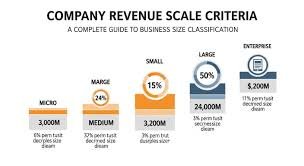
Understanding how companies scale their revenue is essential for evaluating business growth, investment potential, and long-term stability. The concept of company revenue scale criteria examples helps business owners and analysts classify companies based on revenue stages and performance benchmarks.
In this guide by The Daily Business, we break down revenue scaling stages, real-world criteria examples, and how companies move from startup to enterprise level.
What Are Company Revenue Scale Criteria?
Company revenue scale criteria refer to the measurable financial benchmarks used to categorize a business’s growth stage. These criteria are typically based on:
- Annual revenue
- Growth rate
- Market size
- Operational capacity
- Profit margins
Businesses are often grouped into stages such as startup, small business, mid-market, and enterprise.
Company Revenue Scale Criteria Examples by Stage
Here are practical company revenue scale criteria examples used in business analysis:
1. Startup Stage (0 – $1M Revenue)
At this stage, companies are focused on product development and market validation.
Key traits:
- Limited revenue streams
- High investment dependence
- Early customer acquisition
- Unstable cash flow
2. Small Business Stage ($1M – $10M Revenue)
Businesses begin to stabilize and establish a consistent customer base.
Key traits:
- Regular revenue generation
- Small but structured team
- Local or niche market presence
- Initial profitability
3. Growth Stage ($10M – $100M Revenue)
Companies expand operations and scale aggressively.
Key traits:
- Strong revenue growth rate
- Expanding into new markets
- Increased hiring and infrastructure
- Investment in marketing and systems
4. Mid-Market Stage ($100M – $500M Revenue)
At this level, businesses are well-established and competitive.
Key traits:
- Strong brand recognition
- Advanced operational systems
- International or multi-region presence
- Stable profitability
5. Enterprise Stage ($500M+ Revenue)
Large corporations with global influence and diversified revenue streams.
Key traits:
- Multi-billion-dollar potential
- Global operations
- Complex organizational structure
- Strong investor confidence
Why Revenue Scaling Criteria Matter
Understanding revenue scaling is important because it helps:
- Investors evaluate risk and opportunity
- Business owners set realistic growth goals
- Analysts compare companies accurately
- Stakeholders measure performance benchmarks
How Companies Move Between Revenue Scales
Growth between stages depends on several factors:
- Innovation and product demand
- Market expansion strategy
- Operational efficiency
- Funding and investment support
- Customer acquisition strategy
A strong scaling strategy ensures smooth progression from startup to enterprise.
Final Thoughts
The company revenue scale criteria examples framework is a powerful tool for understanding how businesses evolve financially. Whether you are an entrepreneur, investor, or analyst, these benchmarks provide clarity on where a company stands and where it is heading.
The Daily Business aims to simplify complex business concepts so you can make smarter decisions in a competitive market.