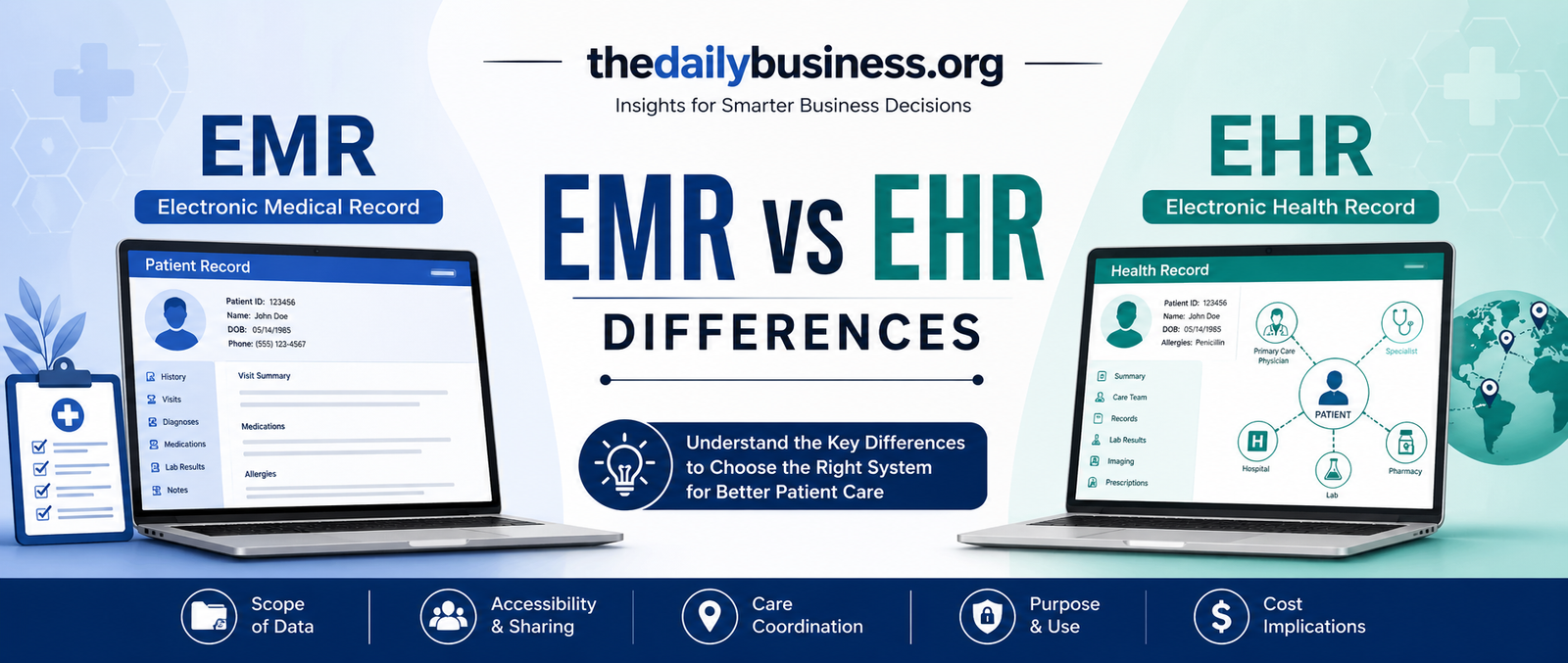
In today’s digital healthcare environment, medical records are no longer stored only on paper. Clinics and hospitals now rely on digital systems to manage patient data efficiently. Two commonly used terms in this space are EMR Electronic Medical Records and EHR Electronic Health Records. Although they sound similar, their functions and scope are quite different.
In this guide by The Daily Business, we break down the key differences between EMR vs EHR so you can clearly understand how each system works and why it matters.
What is EMR (Electronic Medical Records)?
An EMR is a digital version of a patient’s chart within a single healthcare practice.
It includes:
- Medical history
- Diagnoses
- Treatment plans
- Lab results
- Medication records
Key Feature of EMR:
EMRs are designed for internal use only within one clinic or hospital. If a patient visits another provider, their EMR usually does not transfer easily.
Example Use:
A small clinic uses EMR software to track patient visits and treatment progress over time.
What is EHR (Electronic Health Records)?
An EHR is a more advanced system that provides a complete view of a patient’s health history across multiple healthcare providers.
It includes everything in an EMR plus:
- Data from specialists
- Hospital records
- Imaging results
- Lab reports from different facilities
- Long-term health history
Key Feature of EHR:
EHR systems are built for data sharing between different healthcare organizations, making patient care more connected and efficient.
Example Use:
A patient’s records can be accessed by a hospital, lab, and specialist simultaneously for coordinated treatment.
EMR vs EHR: Key Differences
Here are the major differences between EMR and EHR:
1. Scope of Data
- EMR: Limited to one healthcare provider
- EHR: Shared across multiple providers
2. Data Sharing
- EMR: Difficult to transfer outside the clinic
- EHR: Easily shared between hospitals and doctors
3. Purpose
- EMR: Used for diagnosis and treatment within one practice
- EHR: Used for comprehensive patient care across systems
4. Accessibility
- EMR: Restricted access
- EHR: Broad access for authorized healthcare professionals
5. Patient Involvement
- EMR: Limited patient access
- EHR: Often includes patient portals for viewing records
Benefits of EMR Systems
- Easy digital record-keeping
- Faster access to patient data within clinics
- Reduces paperwork
- Improves workflow efficiency
Benefits of EHR Systems
- Better coordination between healthcare providers
- Improved patient safety and care quality
- Reduced medical errors
- More complete patient history tracking
Why Understanding EMR vs EHR Matters
Understanding the difference between EMR vs EHR is important for healthcare providers, administrators, and even patients. It helps in choosing the right system depending on the size and needs of a healthcare organization.
Small practices may rely on EMRs for simplicity, while larger healthcare networks benefit more from EHR systems due to data sharing capabilities.
Final Thoughts
Both EMR and EHR systems play a crucial role in modern healthcare. While EMR focuses on individual practice management, EHR provides a broader, connected healthcare experience.
At The Daily Business, we aim to simplify complex healthcare and business topics so you can make informed decisions with confidence.