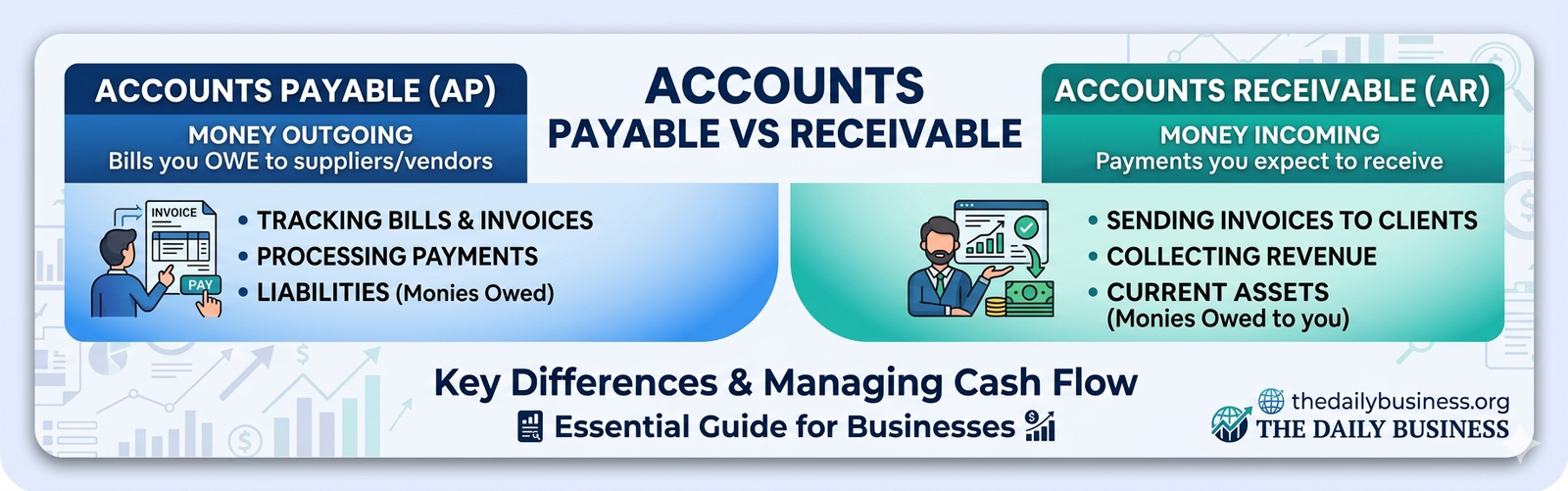
Understanding accounts payable vs receivable is essential for maintaining healthy cash flow and making informed financial decisions. For small and medium-sized enterprises (SMEs), managing these two accounting components efficiently can mean the difference between growth and financial strain. In this guide by The Daily Business, we’ll break down what each term means, how they differ, and why they matter.
What Is Accounts Payable?
Accounts payable (AP) refers to the money a business owes to its suppliers or vendors for goods and services received but not yet paid for. It is recorded as a liability on the balance sheet.
Examples of accounts payable:
- Supplier invoices for raw materials
- Utility bills
- Office rent payments
- Short-term service contracts
Managing accounts payable properly ensures you maintain good relationships with vendors and avoid late fees or penalties.
What Is Accounts Receivable?
Accounts receivable (AR) is the money owed to a business by its customers for products or services delivered but not yet paid for. It is recorded as an asset on the balance sheet.
Examples of accounts receivable:
- Customer invoices
- Outstanding service payments
- Credit sales
Efficient management of accounts receivable helps businesses maintain steady cash inflow and reduce the risk of bad debts.
Key Differences: Accounts Payable vs Receivable
| Feature | Accounts Payable (AP) | Accounts Receivable (AR) |
|---|---|---|
| Definition | Money you owe | Money owed to you |
| Type | Liability | Asset |
| Cash Flow Impact | Outflow | Inflow |
| Managed By | Purchasing/Finance Dept. | Sales/Finance Dept. |
| Goal | Pay on time | Collect quickly |
Why Accounts Payable vs Receivable Matters
Understanding accounts payable vs receivable is crucial for:
- Cash Flow Management: Balancing incoming and outgoing cash ensures liquidity.
- Financial Planning: Helps forecast expenses and revenue accurately.
- Business Growth: Efficient AR collection improves working capital.
- Vendor Relationships: Timely AP payments build trust and reliability.
Best Practices for Managing Accounts Payable
- Automate invoice processing to reduce errors
- Negotiate better payment terms with suppliers
- Schedule payments to optimize cash flow
- Regularly reconcile accounts
Best Practices for Managing Accounts Receivable
- Set clear payment terms and policies
- Send invoices promptly
- Offer early payment incentives
- Follow up consistently on overdue accounts
Common Challenges Businesses Face
- Late payments from customers affecting cash flow
- Poor tracking systems leading to missed invoices
- Overdue liabilities causing financial strain
- Lack of automation increasing manual errors
Addressing these issues early can significantly improve financial stability.
Final Thoughts
When it comes to accounts payable vs receivable, both play equally important roles in your business’s financial health. While AP focuses on what you owe, AR tracks what you’re owed. Managing both efficiently ensures smooth operations, strong relationships, and sustainable growth.
At The Daily Business, we recommend adopting modern accounting tools and maintaining clear financial processes to keep both sides balanced.