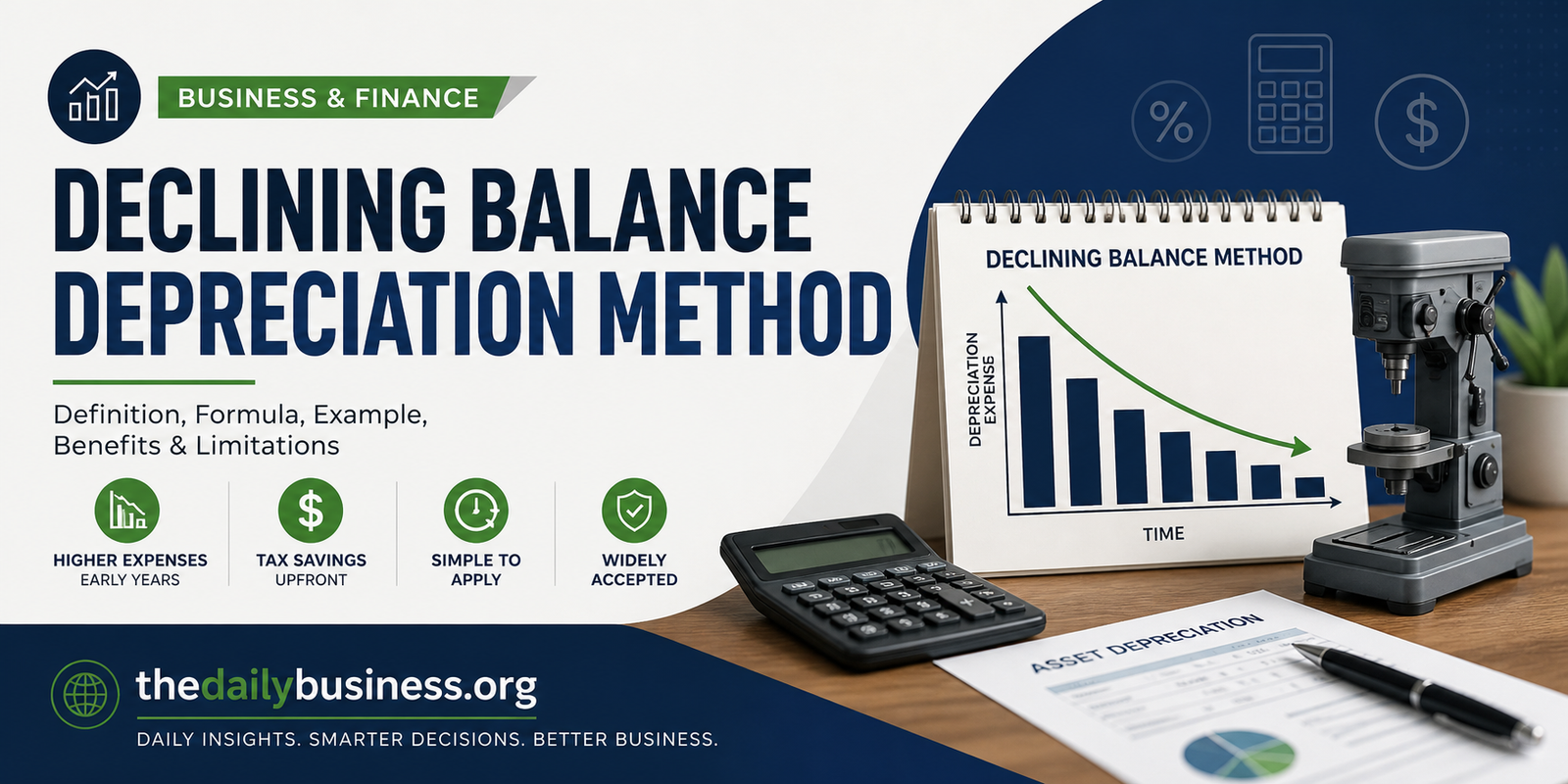
The declining balance depreciation method is one of the most widely used accounting techniques for allocating the cost of an asset over its useful life. It is especially popular for assets that lose value quickly in the early years, such as vehicles, computers, and machinery. This method allows businesses to record higher depreciation expenses in the beginning and lower expenses in later years.
In this guide by The Daily Business, we will break down how the declining balance depreciation method works, its formula, benefits, and practical uses in business accounting.
What is the Declining Balance Depreciation Method?
The declining balance depreciation method is an accelerated depreciation technique. Instead of spreading the cost of an asset evenly over time, it applies a fixed percentage to the asset’s remaining book value each year.
This means:
- Higher depreciation expense in early years
- Lower depreciation expense in later years
- Faster recognition of asset value reduction
It is commonly used for assets that become less efficient or obsolete quickly.
How the Declining Balance Method Works
Under this method, depreciation is calculated based on the asset’s book value, not its original cost.
Each year:
- A fixed depreciation rate is applied
- The value of the asset decreases
- Next year’s depreciation is calculated on the reduced value
This creates a gradually decreasing expense pattern over time.
Formula of Declining Balance Depreciation
The general formula is:
Depreciation Expense = Book Value × Depreciation Rate
Where:
- Book Value = Asset cost – accumulated depreciation
- Depreciation Rate = fixed percentage (often double the straight-line rate in the double declining method)
Example of Declining Balance Depreciation
Suppose a machine costs $10,000 with a 20% depreciation rate.
- Year 1: 10,000 × 20% = 2,000 → Book value = 8,000
- Year 2: 8,000 × 20% = 1,600 → Book value = 6,400
- Year 3: 6,400 × 20% = 1,280 → Book value = 5,120
As you can see, depreciation decreases each year.
Advantages of the Declining Balance Method
1. Matches Real Asset Usage
Assets often lose more value in early years, making this method realistic.
2. Tax Benefits
Higher early depreciation reduces taxable income in initial years.
3. Better Expense Matching
Aligns costs with higher revenue generation periods for new assets.
Disadvantages to Consider
- More complex than straight-line depreciation
- Lower profits reported in early years
- Not suitable for all asset types
When Should Businesses Use It?
The declining balance depreciation method is ideal for:
- Technology equipment
- Vehicles and transportation assets
- Machinery with rapid wear and tear
- Assets that become obsolete quickly
Conclusion
The declining balance depreciation method is a powerful accounting approach for businesses that want to reflect the real-world value loss of their assets more accurately. While it reduces taxable income early on, it provides a more realistic financial picture over time.
At The Daily Business, we help simplify complex financial concepts so businesses can make smarter decisions with confidence.