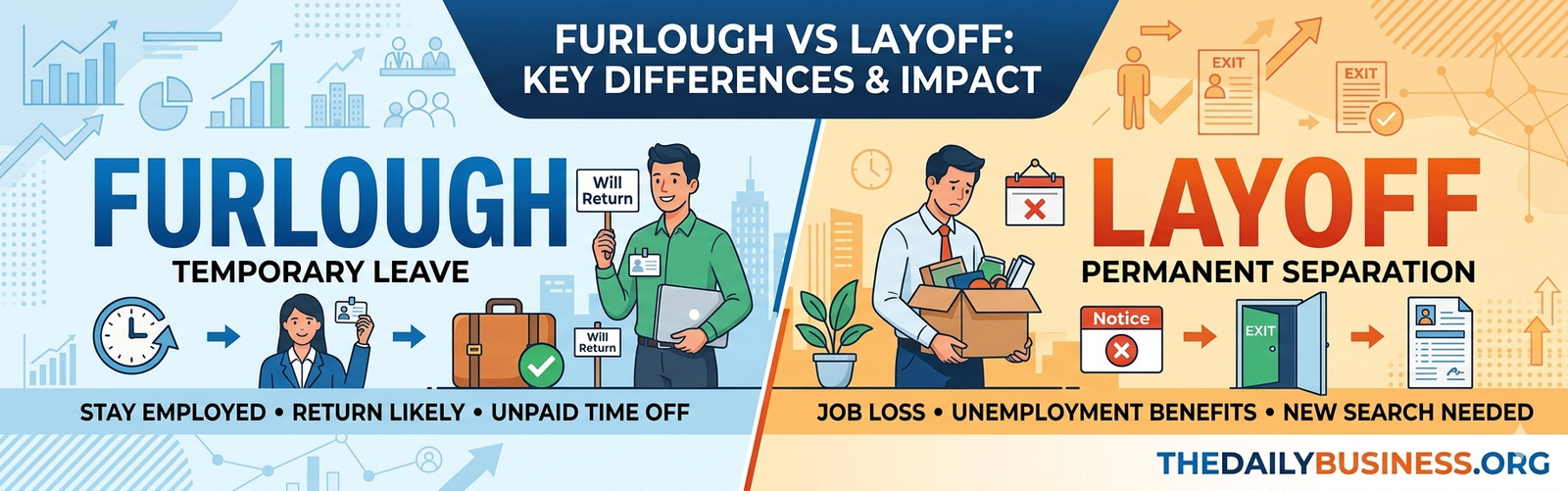
When companies face financial challenges or economic uncertainty, workforce reductions often become unavoidable. Two common approaches are furloughs and layoffs. While they may seem similar at first glance, understanding the difference between furlough vs layoff is crucial for both employees and employers.
In this guide by The Daily Business, we’ll break down what each term means, how they impact workers, and when companies typically use them.
What Is a Furlough?
A furlough is a temporary, unpaid leave of absence. Employees are still officially employed but are required to stop working for a period of time.
Key Features of a Furlough
- Employees remain on the company payroll
- Benefits like health insurance may continue
- Work hours are reduced or paused temporarily
- Employees are expected to return when conditions improve
When Companies Use Furloughs
Businesses often implement furloughs during short-term financial difficulties, seasonal downturns, or unexpected crises. It allows them to reduce costs without permanently losing staff.
What Is a Layoff?
A layoff is a permanent or long-term termination of employment due to business reasons rather than employee performance.
Key Features of a Layoff
- Employment is ended
- Benefits typically stop after a certain period
- Employees may receive severance pay
- Workers must find new employment
When Companies Use Layoffs
Layoffs usually occur when a company is restructuring, downsizing, or facing long-term financial issues.
Furlough vs Layoff: Side-by-Side Comparison
| Feature | Furlough | Layoff |
|---|---|---|
| Employment Status | Still employed | Terminated |
| Pay | Unpaid temporarily | No pay after termination |
| Benefits | Often continue | Usually end after some time |
| Duration | Temporary | Permanent or indefinite |
| Job Security | Higher (expected return) | Lower (must seek new job) |
Pros and Cons of Furloughs
Advantages
- Employees keep their jobs
- Businesses can quickly resume operations
- Benefits may continue
Disadvantages
- No income during furlough
- Uncertainty about return timeline
- Financial stress for workers
Pros and Cons of Layoffs
Advantages
- Companies can significantly cut costs
- Employees may receive severance
- Workers can pursue new opportunities
Disadvantages
- Loss of job security
- Benefits may end
- Emotional and financial strain
Which Is Better: Furlough or Layoff?
There’s no one-size-fits-all answer in the furlough vs layoff debate. It depends on the situation:
- Furloughs are better for short-term challenges where recovery is expected.
- Layoffs are necessary when a company cannot sustain its workforce long-term.
For employees, furloughs generally offer more security, while layoffs may provide a clean break and new opportunities.
How Employees Should Respond
If you’re facing either situation:
- During a furlough:
- File for unemployment benefits if eligible
- Budget carefully
- Stay in contact with your employer
- After a layoff:
- Update your resume
- Apply for unemployment benefits
- Start job searching immediately
Final Thoughts
Understanding the difference between furlough vs layoff can help you make informed decisions during uncertain times. While both options reflect financial challenges within a company, they have very different impacts on employees’ careers and financial stability.
For more business insights and career advice, stay connected with The Daily Business.