By The Daily Business
Understanding company profitability can feel overwhelming, especially when financial jargon gets involved. One of the most widely used financial metrics today is EBITDA. In this guide, The Daily Business breaks down the EBITDA formula explained in simple terms so anyone—from beginners to business owners—can understand and use it confidently.
What Is EBITDA?
EBITDA stands for:
Earnings Before Interest, Taxes, Depreciation, and Amortization
It measures a company’s operating performance without the impact of financing decisions, accounting methods, or tax environments.
In simple words, EBITDA shows how profitable a business is from its core operations.
Investors, analysts, and business owners often use EBITDA to compare companies across industries because it removes factors that can distort profitability.
Why EBITDA Matters
Before diving deeper into the EBITDA formula explained, it’s important to understand why this metric is so popular.
EBITDA helps you:
• Compare companies fairly
• Evaluate operational efficiency
• Understand cash-generating ability
• Analyze potential investments
• Assess business valuation
Because it removes non-operating expenses, EBITDA offers a clearer view of business performance.
EBITDA Formula Explained (Step-by-Step)
There are two common ways to calculate EBITDA.
Method 1: From Net Income
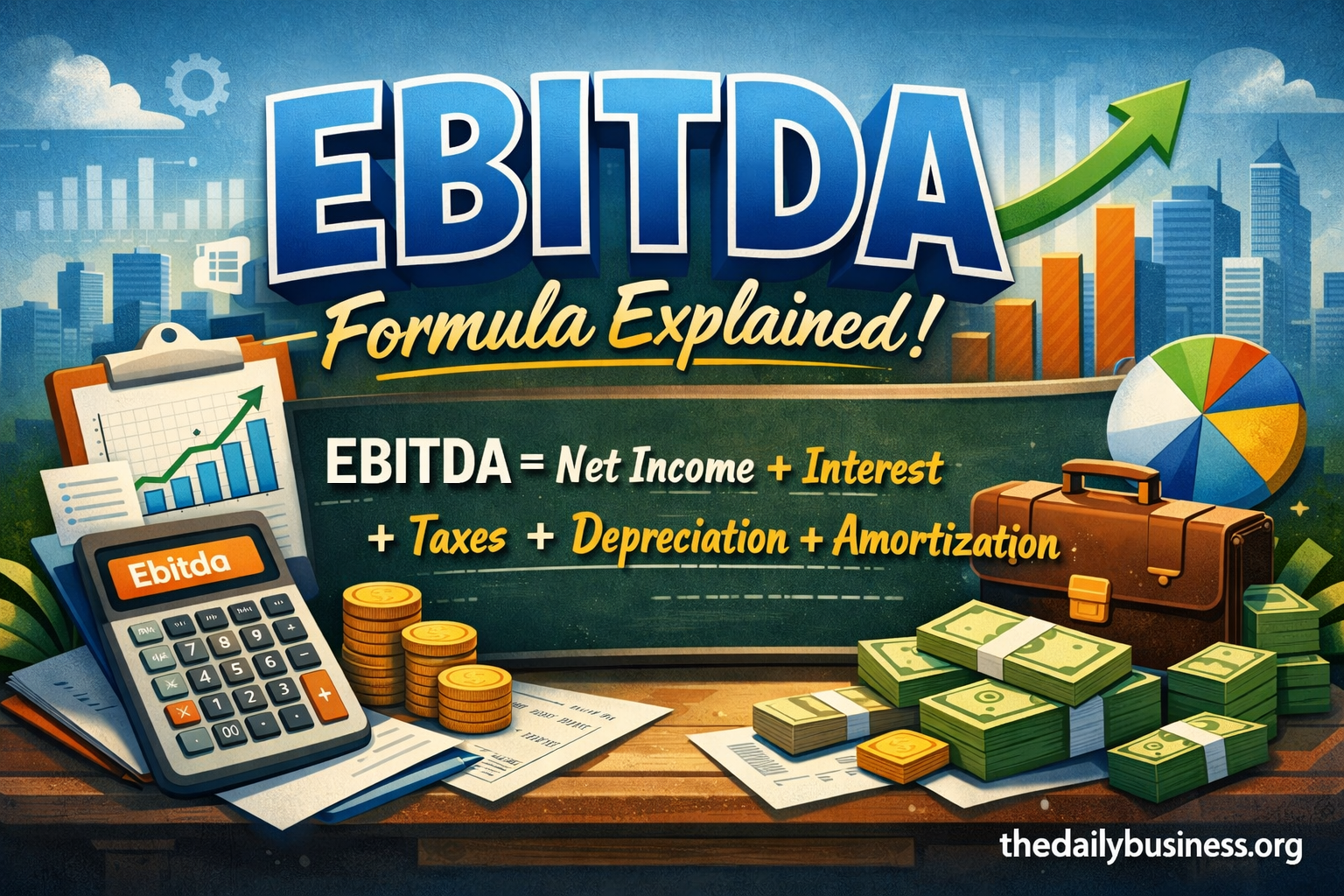
EBITDA = Net Income + Interest + Taxes + Depreciation + Amortization
This is the most widely used version of the EBITDA formula.
Breakdown of Components
Net Income
Profit after all expenses.
Interest
Cost of borrowed money (loans, bonds).
Taxes
Income tax paid to governments.
Depreciation
Reduction in value of physical assets over time.
Amortization
Reduction in value of intangible assets (patents, trademarks).
Method 2: From Operating Income
Another version of the EBITDA formula explained is:
EBITDA = Operating Income + Depreciation + Amortization
Operating income already excludes interest and taxes, making this method shorter.
EBITDA Calculation Example
Let’s make this easier with a simple example.
A company reports:
• Net income: $200,000
• Interest: $50,000
• Taxes: $40,000
• Depreciation: $30,000
• Amortization: $20,000
Apply the Formula
EBITDA = 200,000 + 50,000 + 40,000 + 30,000 + 20,000
EBITDA = $340,000
This means the company generated $340,000 from its core operations.
EBITDA vs Net Profit
Many people confuse EBITDA with profit. They are not the same.
| Metric | What It Shows |
|---|---|
| Net Profit | Final earnings after all costs |
| EBITDA | Profit from operations only |
EBITDA is not a replacement for net profit—but a complementary metric.
Advantages of EBITDA
Understanding the EBITDA formula explained also means knowing its strengths.
1. Easy Company Comparison
Removes differences in tax and financing structures.
2. Focus on Operations
Highlights business performance without accounting noise.
3. Useful for Investors
Often used in business valuation and M&A deals.
4. Shows Cash Potential
Provides insight into cash generation ability.
Limitations of EBITDA
While useful, EBITDA is not perfect.
1. Ignores Debt Costs
A highly indebted company may look healthier than it really is.
2. Excludes Capital Expenses
Equipment and infrastructure costs are not included.
3. Can Be Misleading Alone
Should always be analyzed with other financial metrics.
Financial experts recommend using EBITDA alongside net income, cash flow, and revenue.
When Businesses Use EBITDA
EBITDA is commonly used in:
• Startup valuation
• Mergers and acquisitions
• Investment analysis
• Financial reporting
• Industry benchmarking
It is especially popular in capital-intensive industries like telecom, manufacturing, and technology.
EBITDA Margin Explained
To dig deeper into the EBITDA formula explained, many analysts calculate EBITDA margin.
EBITDA Margin = EBITDA ÷ Revenue
This shows how efficiently a company converts revenue into operating profit.
Example
EBITDA: $340,000
Revenue: $1,000,000
EBITDA Margin = 34%
A higher margin indicates better operational efficiency.
Final Thoughts
Understanding the EBITDA formula explained gives you a powerful tool to evaluate business performance. While it should never be the only metric used, EBITDA provides valuable insight into how well a company operates at its core.